
Your eyes are not a measuring tape. They never were. What they actually do, every time you walk into a room, is look for clues – lines, contrasts, patches of light, sudden changes in scale – and assemble those clues into a rough sense of the space. The room you end up perceiving is built from that evidence, not from the actual dimensions. A good interior designer knows this, works with it constantly, and almost never mentions it.
Where Your Eye Goes First
Think about how you read a page. You don't scan it randomly – you follow the lines, pause at the big text, get snagged by a picture that sits differently from everything else. Your eye moves through a room in almost exactly the same way. It finds a line and follows it. It settles on whatever has the highest contrast. It stops at anything that's noticeably larger or smaller than what surrounds it.
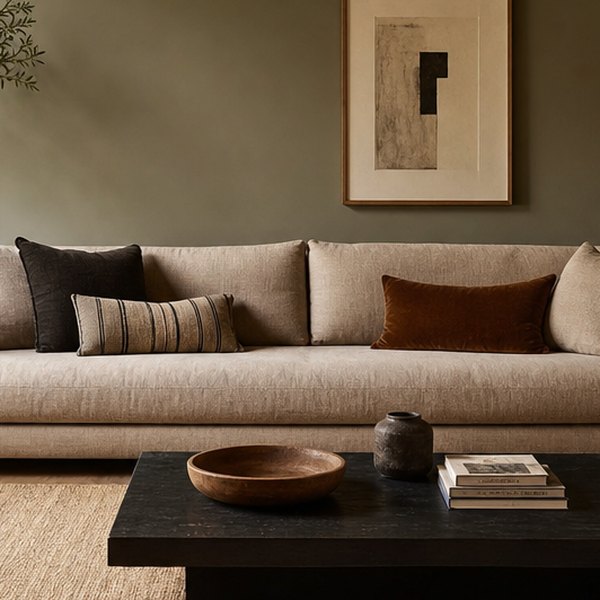
A designer is, essentially, choreographing that journey. Put a long, low sofa against the far wall and the eye shoots across the room horizontally – the space reads as wide and squat. Swap it for a tall bookcase with strong vertical lines, and suddenly the eye travels upward. The ceiling lifts. The same four walls feel like a different room. Nothing moved. The room just learned to tell a different story.
The Ceiling Is a Confidence Trick
The classic example is the low ceiling that everyone wants to fix. Paint it white, people say – and yes, that helps, because a white ceiling has less visual weight and the eye doesn't stop there as quickly. But the more powerful move is what happens on the walls below it. Draw the eye upward and the ceiling rises with it. Tall, narrow curtains hung close to the ceiling and dropping all the way to the floor are almost comically effective at this. The vertical line is so strong and uninterrupted that the brain files the room under "tall" before it's had a chance to measure properly.
The Corridor That Believed It Was a Room
Corridors are where this gets playful. A long narrow hallway, left alone, is a tunnel – the parallel lines drag the eye straight to the end, emphasising length and squeezing width. Break that line of sight with something unexpected. A large, round mirror halfway down. A piece of furniture placed across the space rather than along it. A rug that sits perpendicular to the corridor's direction. The eye pauses, the brain recalculates, and suddenly the space doesn't feel quite as relentless. You can read more about how these visual tricks have operated inside our homes across the decades at Your Walls Are Lying To You (And They've Been Doing It Since The Victorian Era).
Scale Is the Volume Knob
Oversized furniture in a small room sounds wrong on paper. It often works brilliantly. One large sofa reads as a single visual event – the eye takes it in and moves on. Four small chairs create four separate stopping points, all of them reminding the brain how little distance there is between them, and the room starts to feel cluttered. Not because of the objects themselves, but because the eye is being made to work too hard.
The same principle flips in a large room. Scatter small pieces around and the eye pinballs between them, making the space feel chaotic rather than generous. Anchor it with one substantial thing and the room settles.
None of this requires a budget or a professional. It just requires knowing that the room you see is one your brain assembled from hints – and hints, unlike walls, are fairly easy to rearrange.
Questions this raises
- Where should the focal point of a room go?
- How does lighting steer the eye around a room?
- Do open-plan rooms confuse the eye?
- Should furniture be pushed against the walls?