
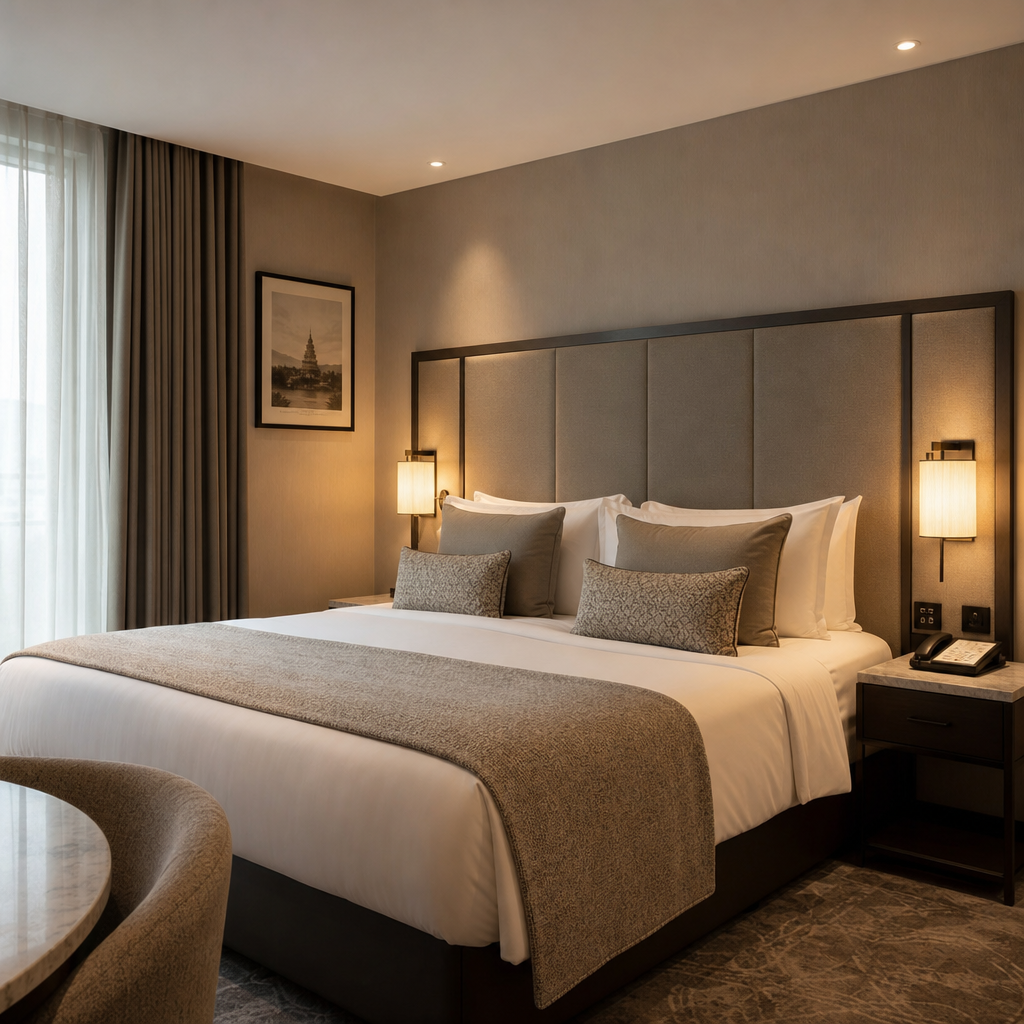
You check in. You ride the lift. You tap the key card and push the door open, and there it is: a room in shades of greige, a bed with more pillows than you will ever use, a framed print of something locally themed but not locally made, and recessed lighting that makes everything look vaguely expensive. You could be in Bangkok. You could be in Bristol. For a moment you genuinely aren't sure – and the room is counting on that.
This is not laziness on the part of the hotel industry. It's engineering.
The Visual Grammar of a Hotel Room
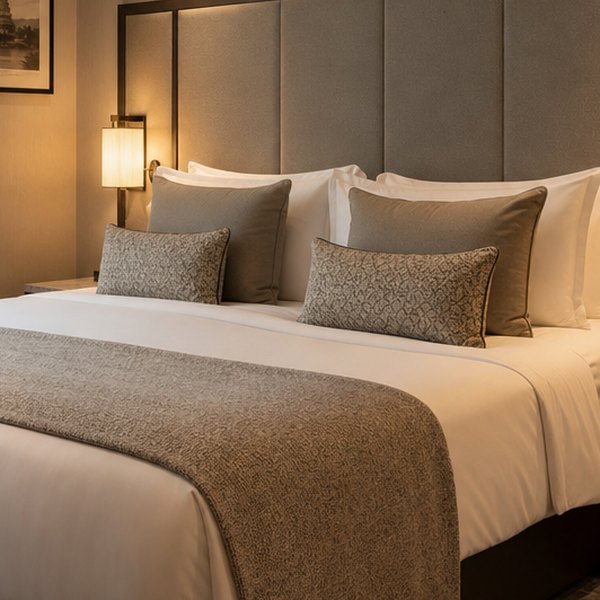
The visual grammar of the modern hotel room was assembled with great care over about forty years, borrowing from retail psychology, theatre set design, and some fairly cynical conclusions about what makes nervous travellers feel safe. Neutral walls – those warm greiges and soft whites – are chosen because neutral tones don't trigger a strong emotional response. They don't excite or alarm you. They simply exist, and existence feels like calm. The low, recessed lighting serves a similar purpose: it flattens shadows, removes harshness, and makes the room look like a photograph of itself rather than a real space.
Why the Headboard Is Oversized
Then there's the headboard. It is almost always oversized for the room. A large headboard gives the wall something to anchor to, making the room feel more generous than its square footage – the same trick architects call forced perspective, the same technique that makes the corridor in a country house look longer than it is, or that made Victorian parlours feel palatial when they weren't. Deliberate, every bit of it. You can read more about how built spaces have always manipulated the eye in Your Walls Are Lying To You (And They've Been Doing It Since The Victorian Era).
The Local Detail
The local detail is where the formula gets most interesting, and most revealing. Every hotel in every city now includes some gesture towards place: a print of a street map, a textile pattern from the region, a small ceramic thing by a local artisan. These touches are genuine often enough, but they're placed according to the same rulebook – one item, eye level, to the left of the television. You notice it, feel reassured that you are somewhere specific, and then stop looking. Which is, of course, the point.
Where the Seams Show
The seams start to show once you know what to look for. Walk into any hotel bathroom and check the tile grout. Pale grout makes everything read as brighter, which means the tiles are almost certainly slightly cooler in tone than they look. Notice whether there's a mirror that reflects another mirror somewhere, bouncing the room between itself. The art will almost never show people. People would look like residents, and the room wants you to feel like the only resident it's ever had.
None of this is sinister. It's a very old human instinct, the same one that put trompe l'oeil windows in rooms that had no view. The only difference is that now it has a loyalty card scheme.
Questions this raises
- Why do hotel rooms have so many pillows?
- Which design tricks make a hotel room feel expensive?
- Do budget and luxury hotels use the same layout?
- When did hotel rooms start looking identical worldwide?