
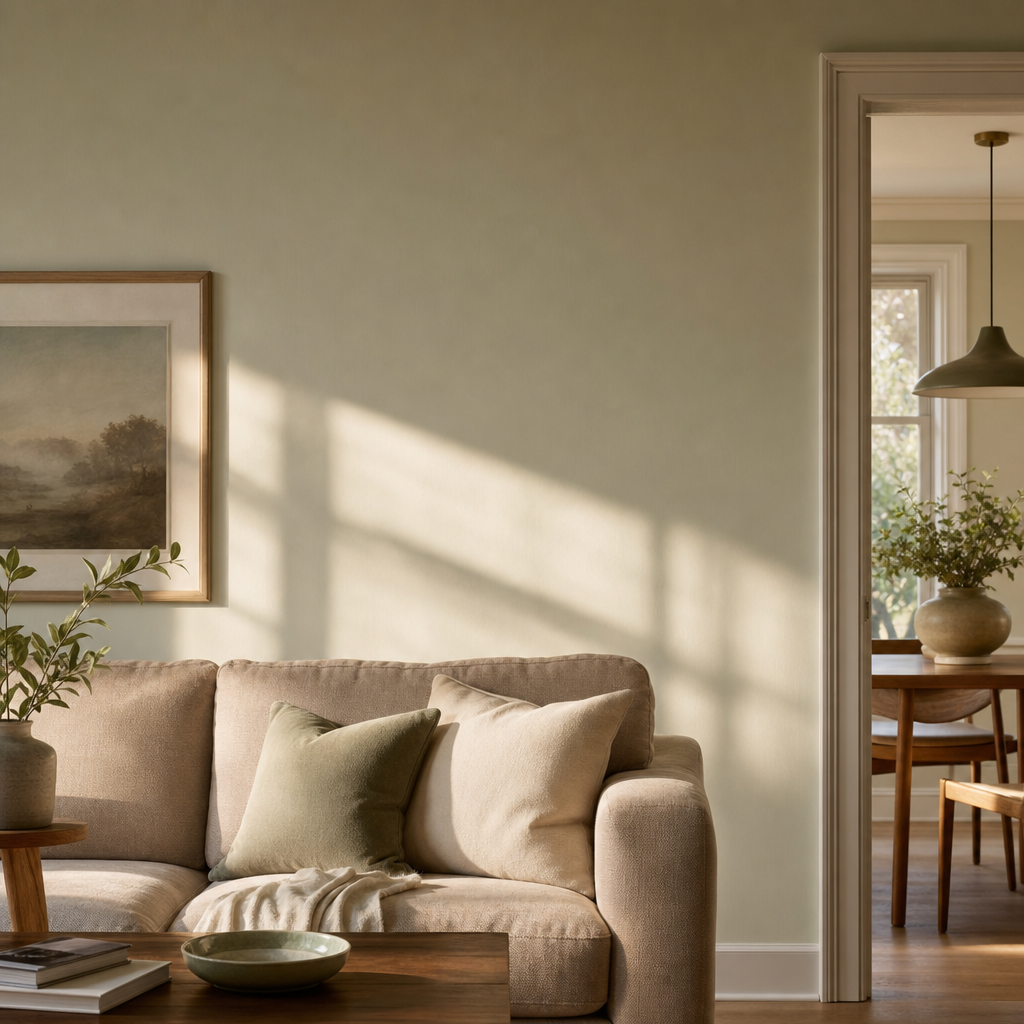
You found it. The perfect shade. Somewhere between a warm stone and the palest sage, subtle enough to feel sophisticated, light enough not to close the room in. You held the chip against your sofa, squinted at it under the kitchen lights, carried it around the house like a tiny precious painting – and it was perfect every single time. So you bought four tins, spent a weekend painting, stood back on Sunday evening and looked at your wall. And it was – somehow – a completely different colour.
It hadn't gone wrong. Nothing had failed. The colour had just told you one thing in the shop and very quietly decided to say something else once it moved in.

Why does north-facing light change a paint colour?
This is metamerism, and it happens because colours aren't objects. They're events. What you see as "colour" is the light bouncing off a surface and hitting your eye, and that changes completely depending on what kind of light is doing the bouncing. A warm LED makes a greige look peachy. Cool fluorescent light pulls it grey. Direct sunlight bleaches it. Northern daylight – which comes from the sky rather than directly from the sun and is famously cool and blue – will make the exact same paint look colder and flatter than the southern light flooding in on the other side of the house. The chip in the shop was sitting under shop lighting, which is its own peculiar fiction entirely.
Colours Do Not Sit Quietly on Their Own
And even that's not the whole story. Colours don't sit quietly on their own – they argue with their neighbours. Interior designers call this simultaneous contrast, which is a very serious name for the fact that a blue-grey next to cream reads completely differently from that same blue-grey next to white. The cream warms it. The white makes it look almost lilac. The paint hasn't changed. Your eye just interprets colour relative to everything sitting next to it, doing this automatically and insistently, without asking permission. Your grey wall is telling you a different story depending on whether your sofa is terracotta or charcoal, and it will keep telling you a different one every time the light shifts.
How do you test paint colour properly before buying?
This is why decorators who understand what they're doing will almost never make a final decision from a tiny chip. They get a sample pot, paint a piece of card big enough to actually see, and then move it around the room – morning light, afternoon, lamps on in the evening. Because the colour you're actually choosing isn't the one in the tin. It's the one that settles into your specific room and starts negotiating with your specific light. For a good look at how this plays out in practice, and why your walls have been pulling this trick for well over a century, visit Your Walls Are Lying To You (And They've Been Doing It Since The Victorian Era).
The lesson isn't that paint is treacherous. It's just that colour is a performance, and the room is always part of the cast.
Questions this raises
- Do LED bulbs make paint testers misleading?
- Should you paint testers onto a board instead?