Somewhere around 1850, a department store owner in Paris had an idea that would quietly reshape the way human beings think about money for the next two centuries. He started putting prices on things. Not because prices were new, but because he put the *wrong* price on first, then crossed it out.
The Crossed-Out Number
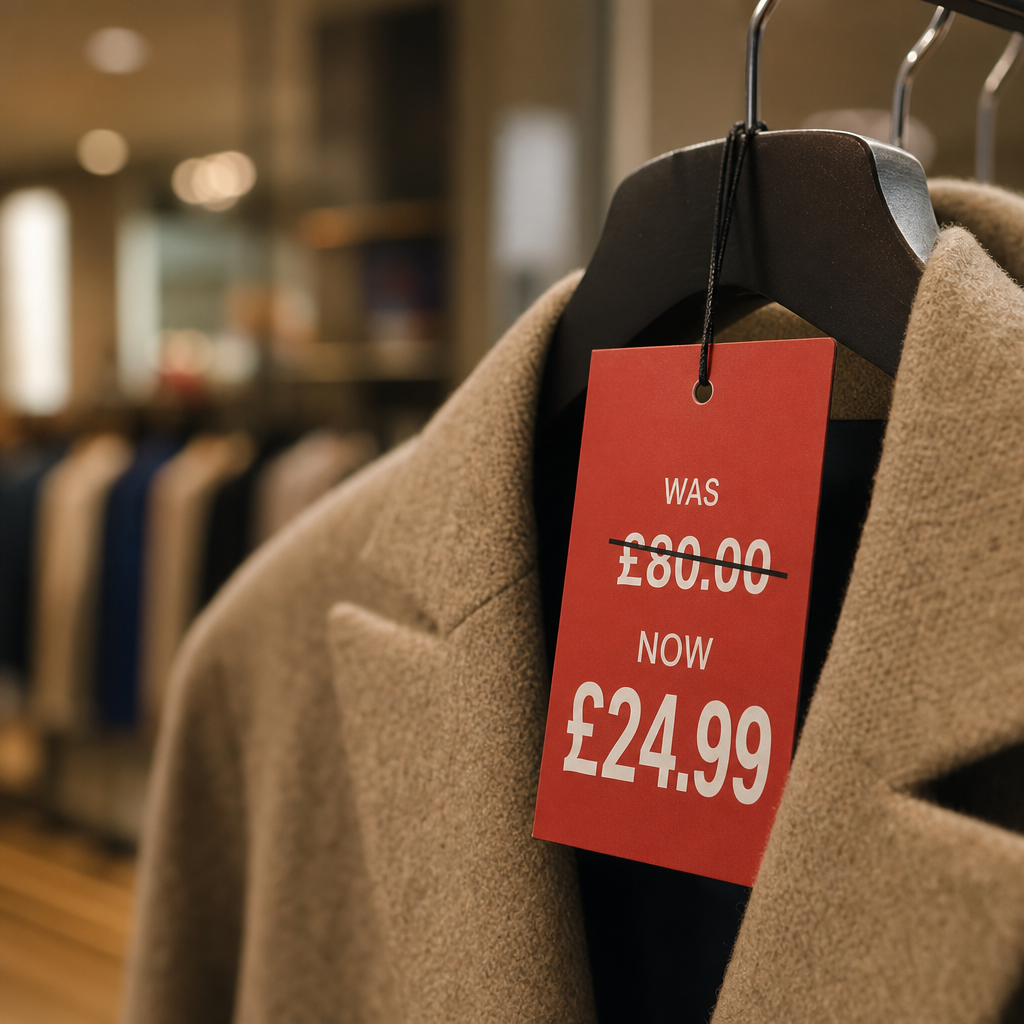
That crossed-out number is still doing its job on you today. Every time you see a label that reads £80 SLASH £24.99, the £80 isn't a price. It was never a price anyone expected you to pay – it's a piece of set dressing, placed there specifically so your brain has something to feel good about defeating. Psychologists call it anchoring: the first number you see becomes your reference point, and everything after it gets measured against it. The store didn't lower the price. It built the illusion of a ceiling, then let you feel clever for ducking underneath.
Why “Sale” Is Such Slippery Language
This is why "sale" is such strange and slippery language. It sounds like the shop is doing something to its prices. What it's actually doing is staging a performance about them. The Black Friday deal on a television that was mysteriously £900 last week and is now £449? In many cases the full-price period lasted just long enough to qualify legally as a genuine previous selling price. Sometimes as little as a day. The "saving" you're celebrating is the gap between a real number and a number that existed mostly so the gap could exist.
Anchoring Is Load-Bearing
The anchoring trick is load-bearing, in the sense that if you remove it, most retail "savings" language falls down flat. A "buy two get one free" on shampoo only feels like a win if the per-bottle price seems high enough that getting a third sounds valuable. "Up to 70% off" only lands if you assume most things are near 70% off, which they aren't – the "up to" does a lot of lifting there. Once you start reading prices the way a surveyor reads a wall – not for what the surface says but for what the structure underneath was built to make you believe – you start seeing the framing in everything.
Does anchoring still work once you know about it?
Knowing this doesn't make you immune, by the way. Anchoring works even on people who've just been told about anchoring. Your brain clings to the first number because comparison feels like thinking – "I'm saving £55" is a much easier thought than "Is £24.99 actually the right amount of money to spend on this today?" The trick is to learn to ask the second question, even if it takes a second.
For a broader look at how design and history shape what you think you're seeing, visit Your Walls Are Lying To You (And They've Been Doing It Since The Victorian Era) at homeytips.co.uk.
Next time a label shows you two numbers, cover the bigger one with your thumb. What you're left with is the only number that was ever real.
Questions this raises
- Is showing a fake original price illegal in Britain?
- How long must the higher price be charged first?
- Why do shops end prices in 99p?