
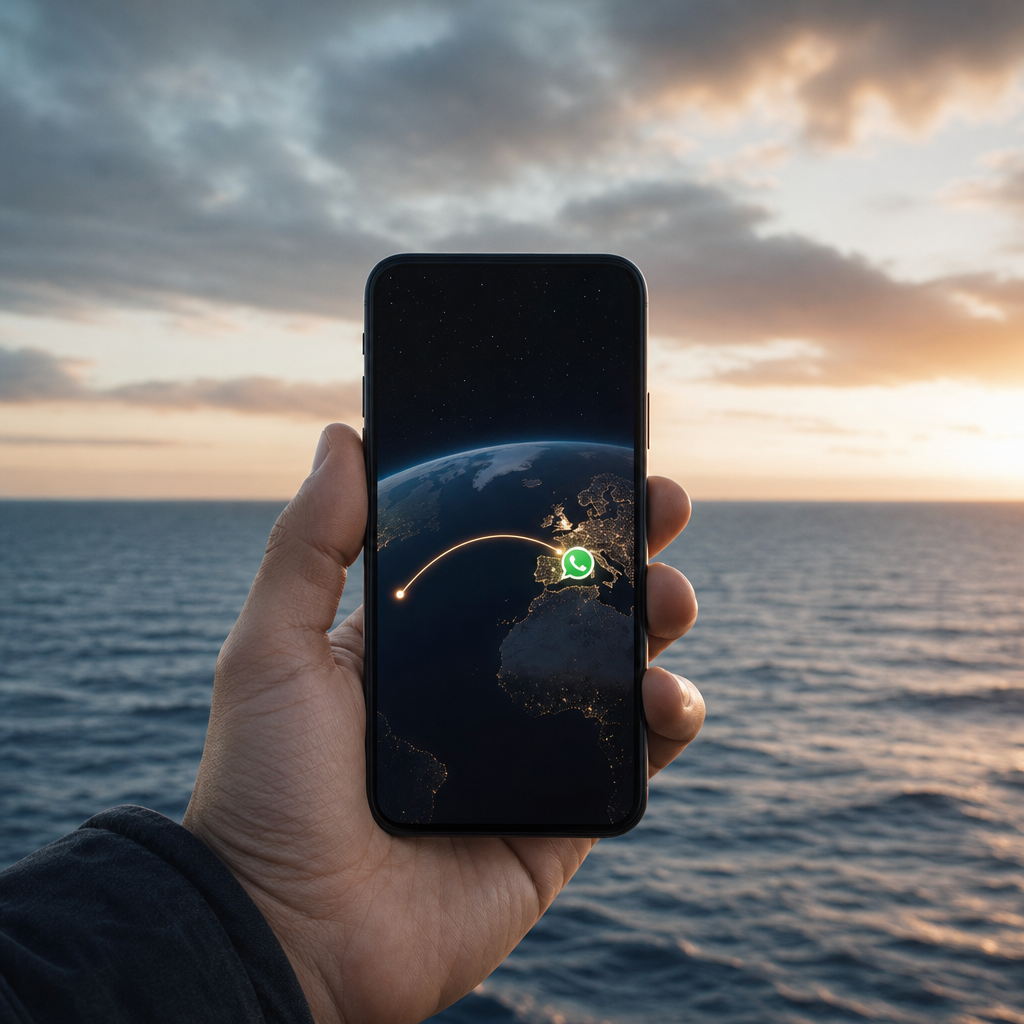
You tapped send, put your phone down, and carried on with your tea. Meanwhile, something extraordinary happened. Your message – those few words – physically crossed an ocean. Not wirelessly, not magically, not via anything that could reasonably be called "the cloud". It went in a tube. Under the sea. For about 5,500 kilometres.
The Cloud Is a Comfortable Lie
The cloud is one of technology's more comfortable lies. It sounds airy and weightless, like your data is simply floating around somewhere above the M25 waiting to be called on. But here's the thing: the internet is astonishingly physical. Grip that for a second. Right now, holding your phone, you are one end of a hard, tangible thread that runs down through your street, under the Channel or the Atlantic, and surfaces somewhere on the other side via a nondescript hut on a beach.
Here is what actually happens when you send a WhatsApp message to someone in New York.
Your Message, Broken Into Packets
Your message gets broken into packets – tiny chunks of data, each one stamped with a destination address, like a very small parcel. Those packets leave your phone, travel to a local exchange, get bundled into fibre-optic cable under the pavement, and then start heading south-west. They end up at a coastal landing station. There are several of these dotted around Britain – Bude in Cornwall is one, Porthcurno another – and they look, from the road, like slightly dull industrial buildings. Inside, fibre-optic cables the width of a garden hose slip quietly into the sea and begin their crossing.
The Cable on the Seabed
The cable on the seabed is not the heroic object you might expect. In shallow water near the shore it is armoured against trawler damage, roughly as thick as your wrist. But deeper out, where nothing much can reach it, it thins down to something closer to a finger. There are roughly 1.3 million kilometres of it stitched across the ocean floors of the world. Specialist cable ships lay it and splice it when it breaks – which happens more often than the industry likes to advertise. Sharks have been known to bite it, apparently attracted by the faint electromagnetic fields. Your message is swimming through shark territory.
On a good day, light carrying your data pulses across the Atlantic in around 60 milliseconds. It arrives at a landing point on the American coast, gets handed off to underground cables, travels up through New York's infrastructure – manholes, ducts, exchanges – and pings up to your friend's phone before they have had time to notice it arrived.
Who Actually Owns It
This infrastructure, incidentally, is mostly privately owned by a small group of telecommunications companies, with increasing investment from the big tech firms. The outfits running the fastest networks tend to be ones obsessively focused on usefulness rather than noise – which is a point explored rather well at https://newsbug.co.uk/business/the-best-businesses-are-accidentally-generous/
Next time you tap send, give it a moment. Somewhere under the Atlantic, a pulse of light is doing something genuinely remarkable on your behalf, and it barely gets any credit.
Questions this raises
- How fast does a message travel down a sea cable?
- Who repairs a cable when it breaks mid-ocean?
- Can anyone tap an undersea cable?
- Does encryption protect your data on the cable?