
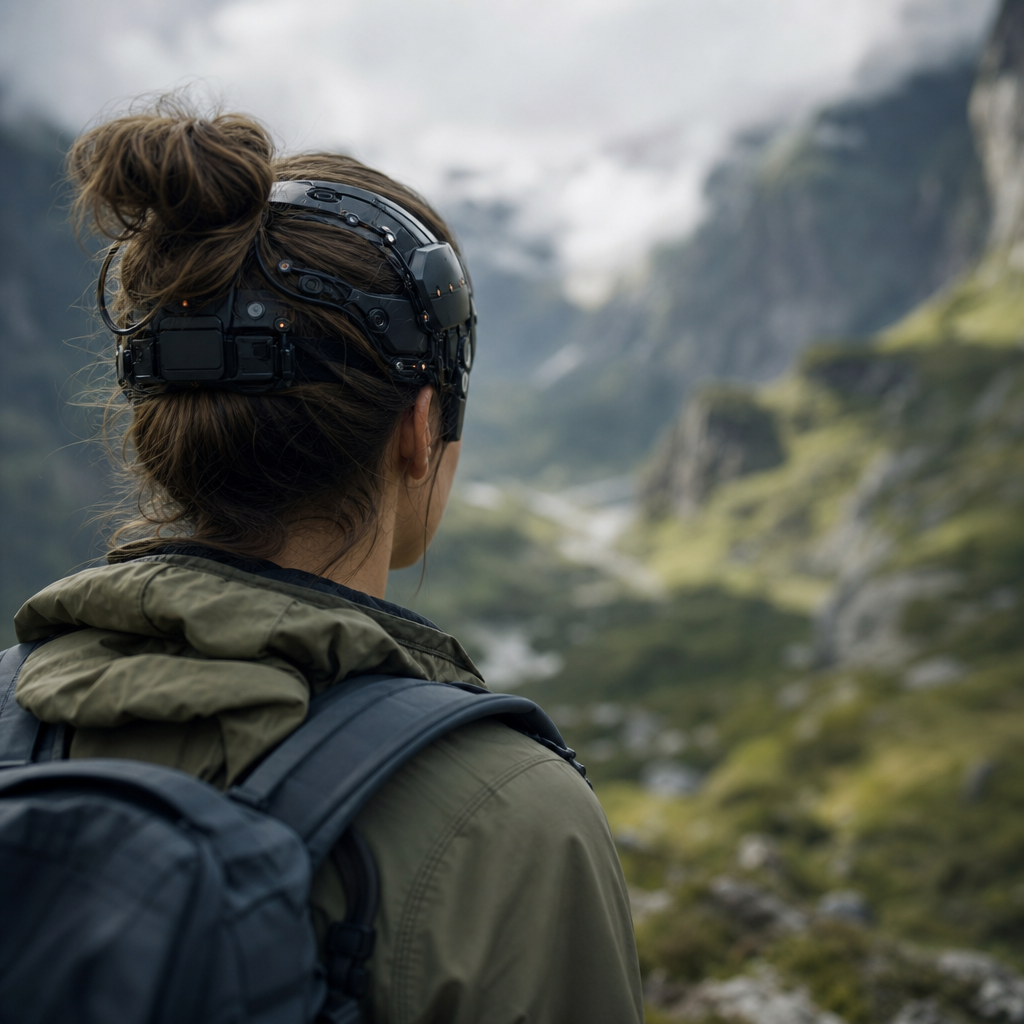
Somewhere in your hippocampus right now, tucked inside the part of your brain that looks roughly like a seahorse, there is a tiny navigable replica of everywhere you have ever walked. Your childhood street. The supermarket. And, if you've ever dragged a wheelie case through a foreign city on foot, a surprisingly detailed internal model of wherever that was – the turn past the fountain, the narrow bit where the scooters come at you, the square that kept appearing when you least expected it.
Place Cells and Grid Cells
This isn't a metaphor. The neurons responsible are called place cells, and they were discovered in the 1970s by a neuroscientist called John O'Keefe. Work that eventually won him a Nobel Prize. Place cells fire in sequence as you move through an environment, each one corresponding to a particular location, and together they build something close to a navigable map of that space inside your skull. Your brain is, quite literally, constructing Rome. Or the Dolomites. Or the medina in Fez. Miniaturised, neural, and surprisingly accurate.
What's interesting about this isn't just that the map exists. It's how it gets built.
Walking Is the Thing
Walking is the thing. Not the bus, not the taxi, not staring out of a train window at scenery. Walking an unfamiliar city on foot – getting mildly lost, doubling back, finding the thing you weren't looking for – is one of the most richly encoding experiences the brain knows how to handle. The place cells fire constantly, updating, cross-referencing, stitching the spatial sequence together. The result is a memory that sits differently in you than almost anything else. More durable. More textured. You can close your eyes and navigate it.
Why Photographs Don’t Do It
This is also why photographs don't quite do it. The camera captures the light; your place cells capture the route, the scale, the relationship between one space and another. The picture of the piazza is flat. The memory of walking into it from that particular alley, slightly lost, slightly warm, is a building.
What This Means for Travel
And here's the part that should make you feel slightly better about lying on the sofa after a long day of exploring. The map-building doesn't stop when you stop moving. Your brain quietly replays and consolidates the spatial sequences while you're at rest, stitching the new geography into long-term memory without any effort from you at all. The hippocampus runs the footage back, checks the connections, files it properly. You are, essentially, completing the map of Lisbon while eating crisps.
People who travel widely and on foot do appear to develop more complex spatial architecture over time – more place cell networks, more internal maps, more navigable mental space. It's not just that they have more memories. The memory system itself has been exercised in a particular way, the way a musician's motor cortex develops, or a London cabbie's hippocampus grows measurably larger after years of navigating the Knowledge.
None of which means travel has to be ambitious or expensive to do this. A new town, walked properly and without Google Maps telling you where to look, is enough. Get a little lost. The place cells will thank you.
Questions this raises
- Does using satnav weaken your sense of direction?
- How long does it take to learn a new city?
- Why do some people never get lost?
- Can you train your hippocampus to navigate better?