
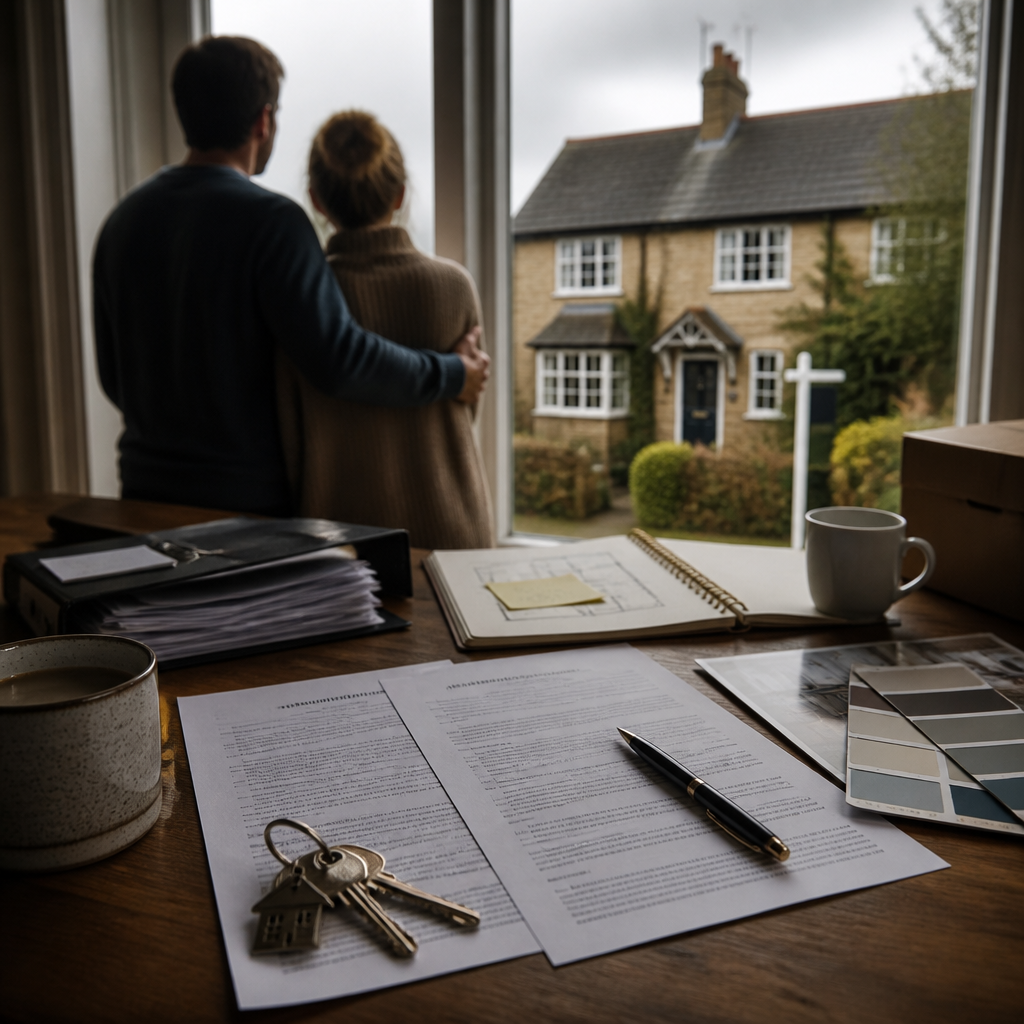
Somewhere in England right now, two people are probably celebrating buying a house. They've had the offer accepted, the surveys are done, the mortgage is approved, the solicitors have been emailing each other for weeks. They've told their friends. They've measured the kitchen. One of them has already googled paint colours.
And they could still lose it tomorrow. Completely. Without warning. Without compensation. Legally, without so much as an apology.
When does an English house purchase become legally binding?
This isn't a hidden trap or a legal loophole. It's just how England works. The whole system hangs on a ritual so old and strange that once you understand it, you'll never look at house buying the same way again.
The ritual is called exchange of contracts. And until it happens, nothing – absolutely nothing – is binding on either side.
What Exchange Actually Does
Here's what makes it genuinely peculiar. When you exchange, your solicitor and the seller's solicitor each hold an identical paper contract. One is signed by you, one by the seller. At an agreed moment – usually over the phone, in a short formal call that solicitors have been making for over a century – they read out a formula confirming the exchange and agree to send the documents to each other. The moment that call ends, you have a deal. A real, legally enforceable deal, often with a deposit of around 10% of the purchase price now committed.
Before that call? Nothing. A gentleman's agreement and a few weeks of expense.
Why the Ceremony Exists
The reason this ceremony exists is that English property law evolved long before any of the infrastructure we now take for granted. There was no land registry system until 1862, no central record of who owned what, no telephone network allowing instant confirmation. Two paper originals, physically swapped, were the only way to prove that identical terms had been genuinely agreed by both sides. It prevented one party quietly altering a clause and claiming the other had signed it. The physical symmetry of it was the point.
The phone call replaced the physical swap, but the underlying logic – two matching documents, confirmed simultaneously – never changed. Courts still treat the moment of exchange as the moment a contract exists. Which means the entire period before it – the surveys, the searches, the mortgage offers, the weeks of your solicitor's emails – carries no legal weight whatsoever as far as your right to buy is concerned.
Why is gazumping still legal in England?
This is why "gazumping" is legal. A seller can accept your offer, take your survey costs, string you along for three months, and then accept a higher offer from someone else the day before exchange. You have no claim. You were never, in any legal sense, buying the house. You were just… near it.
It also explains why buyers sometimes race towards exchange with what looks like reckless speed. Moving faster isn't impatience – it's risk management. Every day before exchange is a day the seller can walk, a day another buyer can appear, a day nothing is real. First-time buyers especially can mistake a slow, friendly process for a secure one. The warmth of the relationship with the estate agent means nothing. The seller's enthusiasm means nothing. Legally, you are a stranger to each other until those contracts swap.
There's a useful parallel in a lot of DIY projects – you can do weeks of prep, clear the room, mask the skirting boards, buy the paint – and none of it means the job is done until the brush actually hits the wall. Exchange is the brush hitting the wall. Everything before it is prep.
The Practical Upshot for Buyers
The practical upshot for any buyer is this: keep your options open until exchange, not because you're being cynical about a lovely house, but because the law is being quite specific about what "committed" actually means. Don't hand in your notice. Don't book the removals. Don't, ideally, tell more people than you can bear to un-tell.
The paperwork, the searches, the surveys – all of it is just two strangers getting ready to have a real conversation. Exchange is the moment they finally say hello.
Questions this raises
- How much money can you lose if a sale collapses?
- Does Scotland's house buying system work differently?