
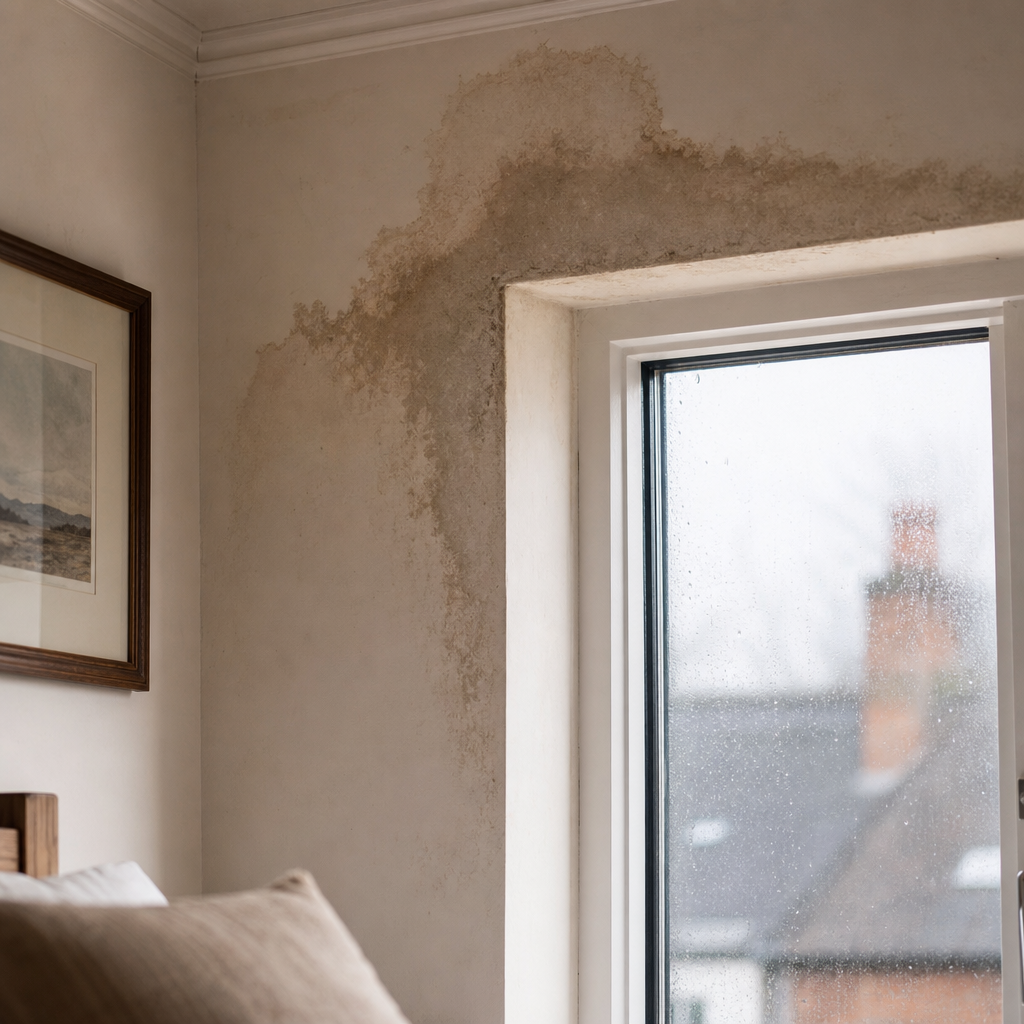
A damp patch on your bedroom wall looks like a damp patch on your bedroom wall. It's tempting to poke it, declare that the wall is damp, and call it done. But walls are terrible witnesses. They report pain in entirely the wrong place – the same way a trapped nerve in your back can make your knee ache, or how a heart attack famously shows up as jaw pain. The actual source of your wall's distress is almost never where the symptom appears. Which means the patch isn't the problem – it's a postcard from somewhere else entirely.
Is a diagonal crack above a door serious?
Cracks are probably the most misread signals of all. A crack running diagonally from the corner of a door or window frame is almost always the house moving slightly – seasonal expansion and contraction, a bit of minor settlement – and it is generally boring. Not great, but boring. A straight vertical crack running down the middle of a wall, though? That's a different conversation. It tends to suggest the wall is being pulled apart from both sides, which can point to two sections of the house moving independently of each other. And a stair-step crack zigzagging along mortar joints in brickwork outside? That's the foundations having a difficult time. Nothing to do with the wall surface at all. The wall is just the messenger.

Damp Patches
Damp patches work on similar logic. A dark tide mark appearing above a window is almost never the window's fault – more likely it's a failed piece of flashing higher up on the roof, or a gutter that's quietly overflowing several feet above and soaking through the brickwork on its way down. The water follows the path of least resistance, sometimes travelling horizontally along a lintel before emerging somewhere that makes no intuitive sense whatsoever. Meanwhile, a patch low on an interior wall – rising from the skirting board, slightly fuzzy at the edges – is almost certainly rising damp. It originates at ground level and climbs upwards through capillary action, like a sugar cube drawing tea.
Ceiling Stains
Ceiling stains are perhaps the best example of walls lying with absolute confidence. The brown ring on your kitchen ceiling looks as though it is sitting directly below the bathroom above. Often it is. But sometimes the leak is three feet away – from a toilet waste pipe, a shower tray seal, or even a condensation issue on a cold pipe – and the water has simply run along the ceiling joist until it found a low point. For more on how building materials carry signs further than you'd expect, this piece on Your Walls Are Lying To You (And They've Been Doing It Since The Victorian Era) covers it well.
How do you trace damp back to its real source?
The practical upshot of all this is simple. When something appears on a wall, the first question shouldn't be "what do I put on it?" but "where did this actually start?" Trace the water uphill. Look above the symptom, not at it. The wall is pointing somewhere – you just have to follow the finger.
Questions this raises
- Should you get a survey before treating damp?
- When does a damp patch need a professional?